A particular kind of silence falls on a trading floor when war breaks out. This isn’t a silent room; it’s the sound of a thousand screens going red in unison, while the world’s most powerful people look on aghast as their spreadsheets suddenly become worthless. That silence lasted about three seconds before chaos began on Saturday, 28 February 2026, when the first strikes hit Tehran.
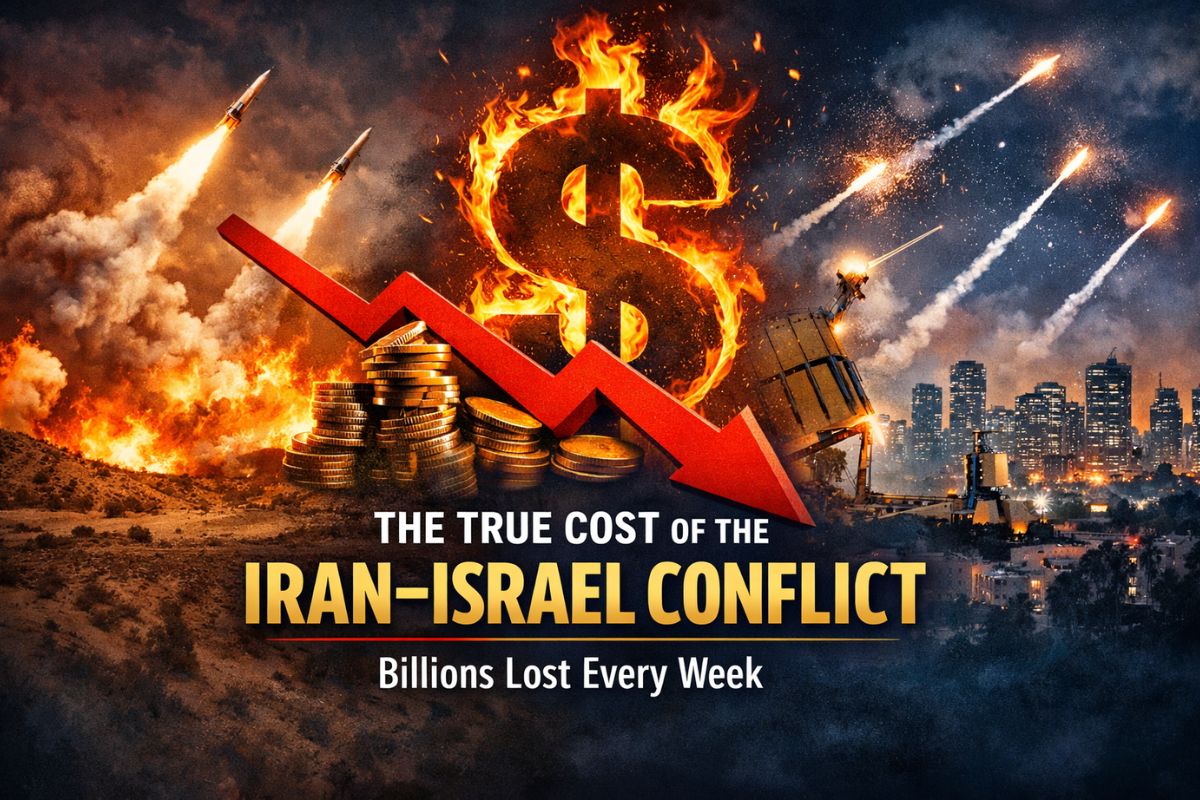
Now, on 5 March 2026, we aren’t just looking at a regional skirmish. We are looking at a bill. And whether you’re a tech worker in Tel Aviv, a commuter in London, or a factory owner in Mumbai, you’re going to be the one paying it. Honestly, it’s hard to wrap your head around the numbers.
We talk in trillions and billions, but those are just abstract concepts until you see the cost of the Iran–Israel conflict reflected in the price of a litre of petrol or the sudden disappearance of “next-day delivery” for your electronics. This isn’t just a “security issue”. It’s a systemic breakdown of the global machine we’ve all taken for granted. Let’s cut to the chase and try to answer the question, “How much is the Iran–Israel conflict is really costing?“
The Immediate Financial Hemorrhage in Israel
Look, the numbers coming out of Israel’s Finance Ministry are staggering. They estimate that the current “Red” alert restrictions are draining roughly $3 billion (NIS 9.4 billion) every single week. Imagine that. In the time it takes you to finish your workweek, $3 billion has just… evaporated. Why so much? Because when the Home Front Command shuts down schools and non-essential offices, the engine stops.
Thousands of high-tech workers—the literal backbone of the Israeli economy—are swapping their laptops for rifles as part of the massive reserve mobilisation. According to reporting from The Times of Israel, the Finance Ministry is begging the military to drop the alert level to “Orange” just so people can get back to work. If they don’t, the growth gains of 2025 won’t just stall; they’ll be wiped out by the end of the month.
The Chokepoint: Why Your Energy Bills Are About to Jump
The real horror story, though, is happening at the Strait of Hormuz. Iran’s blockade of this tiny stretch of water has effectively cut off 20 million barrels of oil a day. That’s 20% of what the entire planet consumes. Within 48 hours, Brent Crude oil prices shot from $70 to over $82 per barrel. But it’s not just oil. Think about the heating in your home. Qatar has halted its LNG production at Ras Laffan because they can’t get the ships out. European gas prices (the Dutch TTF) spiked by 47% in a single day. If this blockade lasts another fortnight, analysts warn we’re looking at $100+ oil.
The “Logistical Paralysis” of the High Seas
Here’s something most people don’t think about: insurance. You can’t sail a ship into a war zone without it. As of today, 5 March 2026, major insurers like Gard and Skuld have basically ripped up their “war risk” cover for the Persian Gulf. If you’re a captain, you’re either staying anchored or you’re taking the long way round. Rerouting a cargo ship around the Cape of Good Hope takes 10 to 15 additional days.
That is extra fuel, extra wages and a huge bonk to the “just-in-time” supply chains we depend upon. The real cost of Iran–Israel Conflict isn’t just the missiles; it’s the fact that the iPad or car parts you ordered might now be sitting on a boat somewhere off the coast of South Africa, burning through cash.
The UK Connection: A Living Standards “Whiplash”
Back in Britain, the timing couldn’t be worse. Chancellor Rachel Reeves just gave a Spring Statement that promised a £300 rise in living standards for the average family. But as the Resolution Foundation warned this week, this conflict could add £500 to annual energy bills and push inflation up by a full percentage point. Essentially, the war in the Middle East has just handed every British household a bill that wipes out their entire pay rise for the year. It’s a “whiplash” effect—one day you’re told things are getting better, and the next, the RAC is reporting that petrol prices have jumped 3p a litre in 72 hours.
Also Read: Humanitarian Crisis in the Middle East: Civilians Caught in Iran-USA War Crossfire
The $3.2 Trillion Global “Vanish”
In the last 96 hours, the world’s stock markets have lost $3.2 trillion in value. That’s not a typo. In Tokyo, the Nikkei took such a beating that they had to trigger emergency trading halts. In Seoul, the KOSPI suffered its worst crash since 2008. The crazy part? This isn’t just “rich people losing money.” This is your pension fund. This is the capital that companies use to hire new staff. When the market panics, everybody loses.
The Reality Check: Who Wins and Who Loses?
| Factor | The Current Reality | The 2026 “Danger Zone” |
|---|---|---|
| Israel’s Weekly Bill | $3 Billion | Bankrupting growth by April |
| Oil Prices | $82 / barrel | $100+ within two weeks |
| Shipping Delay | +15 Days | Supply chain collapse for electronics |
| UK Energy Bills | +£500 forecast | Wiping out 2026 wage growth |
So, What Happens Next?
The truth is, wars are rarely settled by the people fighting them; they’re settled when the money runs out. Right now, the global economy is bleeding. We are watching a “geopolitical shock” that is making the 2022 energy crisis look like a warm-up act. The question you have to ask yourself isn’t just about who “wins” the military battle. It’s about how much of your own savings you’re prepared to lose in the process. Because right now, every day this blockade continues, the price tag goes up. And there’s no “refund” on the way. Anyway, that’s where we are. A £500 energy hike and a world on edge. Anyone else miss 2024?
FAQs on the Economic Fallout
How much has the price of petrol gone up in the UK?
Just so you know, the cost of petrol has risen by roughly 2.5p per litre since Saturday and diesel by more than 3p, according to the RAC – and if oil holds above $81, we can expect further spikes at the pump.
Will my Amazon orders be delayed?
If the products are coming from Asia, yes. Big shipping lines such as Maersk are rerouting ships around Africa, which adds an additional 15 days onto delivery time.
Why is the Strait of Hormuz so important?
It’s the world’s biggest energy chokepoint. About 20% of the world’s oil and 20% of its liquefied natural gas pass through that narrow gap. If it’s blocked, the world’s energy supply effectively takes a 20% hit overnight.
Is this going to cause a recession?
Goldman Sachs and Oxford Economics have both warned that if the conflict isn’t settled within the next 4 weeks, the resulting energy spike and market crash could trigger a global contraction similar to the 2008 financial crisis.
Sources and References
- The Times of Israel: Finance Ministry warns of $3 billion weekly loss
- The Guardian: War could wipe out UK living standards growth
- SpecialEurasia: Geoeconomic Assessment of the March 2026 Conflict
- Wikipedia: Economic Impact of the 2026 Iran Conflict
Recommended