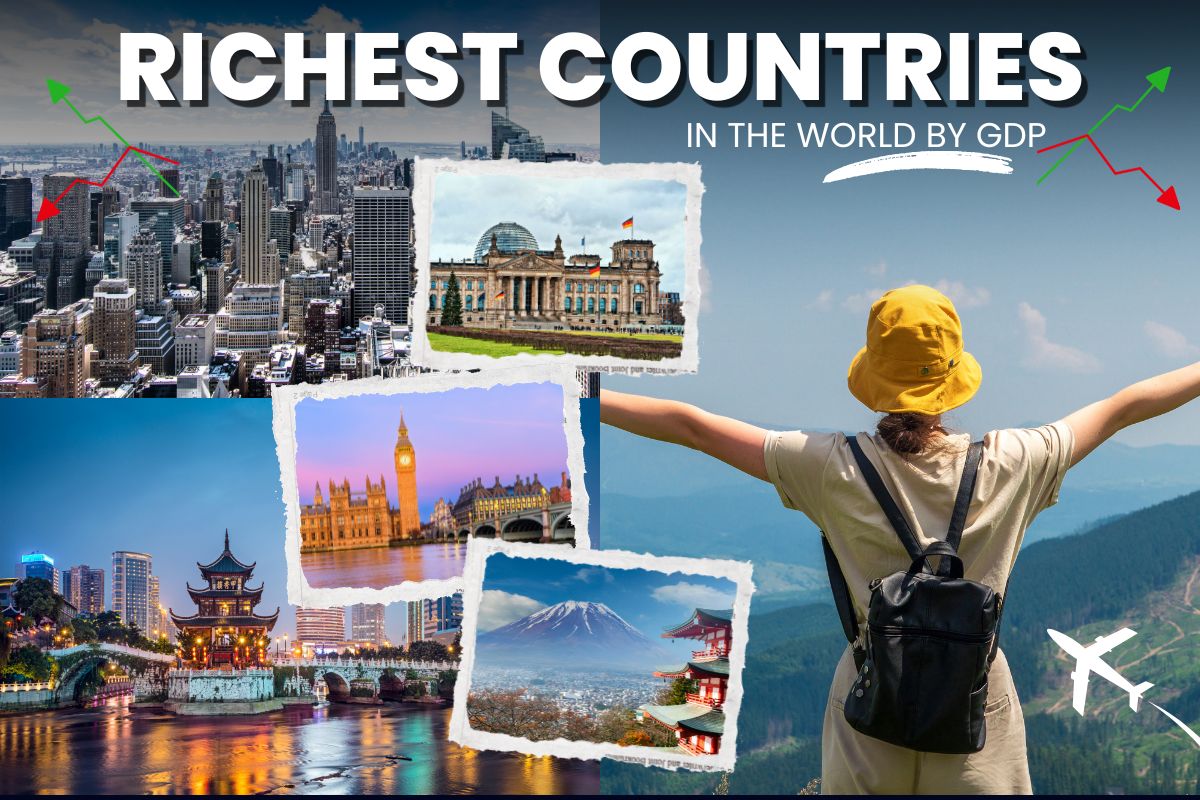
As one seeks to discuss the wealthiest nations on earth, he/she will most likely refer to Gross Domestic Product (GDP). Gross Domestic Product (GDP) is the total monetary value of all final goods and services produced within a country’s borders during one year. It measures the size of the economy in a particular nation.
The high GDP does not necessarily reflect the prosperity of all the citizens in such a country. It simply means that there is a lot of production taking place. The countries with very high GDPs can be those whose populations or whose GDP per capita is high.
This article features the Top 20 Richest Countries in the World by GDP (2026). Here, the GDP growth rate of each country and GDP per capita are shown.
- The USA has the world’s largest economy, with its GDP standing at more than $32 trillion.
- China is still ranked as the second-largest economy and continues growing through trade and manufacturing.
- The United Kingdom is one of the five largest economies by GDP in the world.
- India has one of the fastest GDP growth rates among the world’s six largest economies in 2026.
- GDP is an indicator of the size of the economy, while GDP per capita is the average income.
What Is GDP?
GDP means Gross Domestic Product. This is the total value of the GDP, which includes all final goods and services produced within a country.
The indicators that may show a nation having a high GDP would be as follows:
- Economy of a significant size
- Presence of a lot of businesses
- Active foreign trade
- High levels of expenditure and investments
- Large workforce
- High productivity
- Strong domestic consumption
GDP is a good indicator to measure the size of different economies across the globe.
Top 20 Richest Countries in the World by GDP (2026)
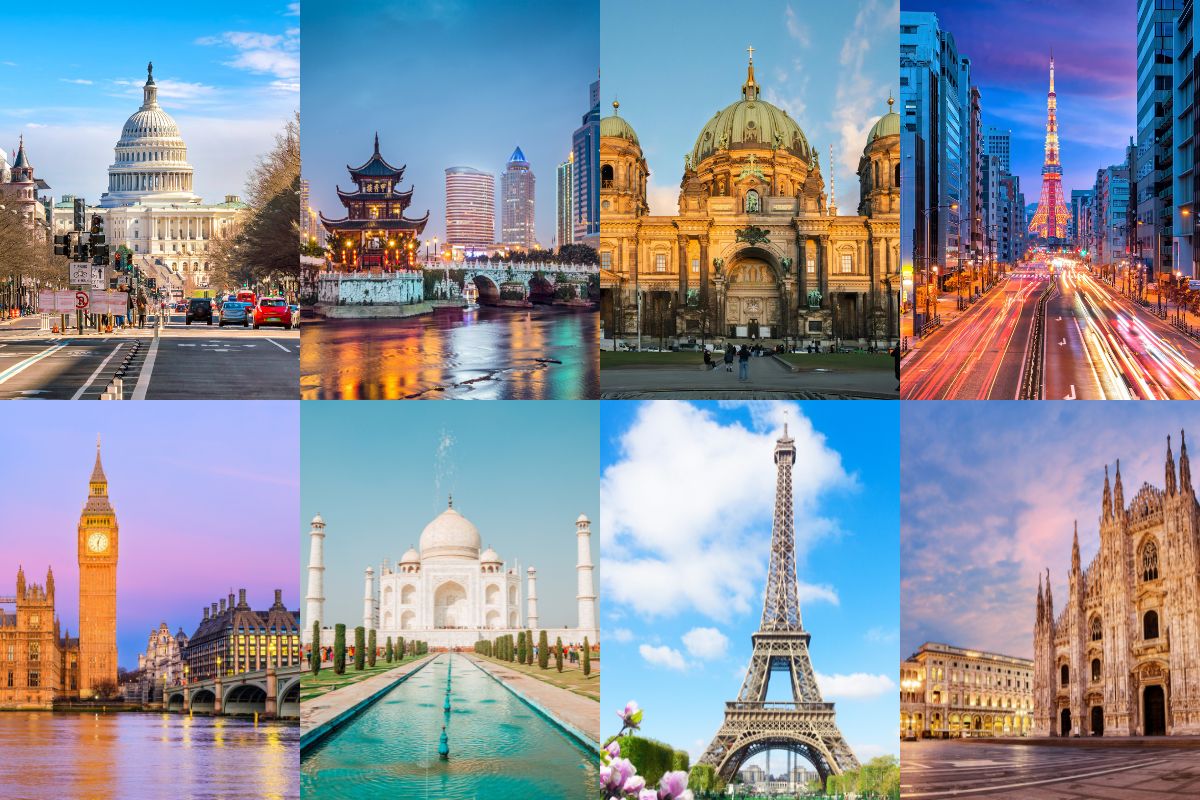
The table below shows the latest estimates for the world’s largest economies in 2026.
| # | Country | GDP | GDP (Full Value) | GDP Growth | GDP per Capita |
|---|---|---|---|---|---|
| 1 | United States | $32.38 trillion | $32,383,920,000,000 | 2.32% | $94,430 |
| 2 | China | $20.85 trillion | $20,851,593,000,000 | 4.41% | $14,874 |
| 3 | Germany | $5.45 trillion | $5,452,858,000,000 | 0.79% | $65,303 |
| 4 | Japan | $4.38 trillion | $4,379,253,000,000 | 0.72% | $35,703 |
| 5 | United Kingdom | $4.26 trillion | $4,264,794,000,000 | 0.80% | $61,056 |
| 6 | India | $4.15 trillion | $4,153,191,000,000 | 6.48% | $2,813 |
| 7 | France | $3.60 trillion | $3,596,094,000,000 | 0.86% | $52,083 |
| 8 | Italy | $2.74 trillion | $2,738,164,000,000 | 0.52% | $46,505 |
| 9 | Russia | $2.66 trillion | $2,656,452,000,000 | 1.09% | $18,525 |
| 10 | Brazil | $2.64 trillion | $2,635,912,000,000 | 1.91% | $12,313 |
| 11 | Canada | $2.51 trillion | $2,507,340,000,000 | 1.50% | $60,305 |
| 12 | Australia | $2.12 trillion | $2,123,963,000,000 | 2.01% | $75,648 |
| 13 | Mexico | $2.12 trillion | $2,120,855,000,000 | 1.64% | $15,779 |
| 14 | Spain | $2.09 trillion | $2,091,222,000,000 | 2.09% | $41,563 |
| 15 | South Korea | $1.93 trillion | $1,931,008,000,000 | 1.86% | $37,412 |
| 16 | Turkey | $1.64 trillion | $1,640,223,000,000 | 3.37% | $19,018 |
| 17 | Indonesia | $1.54 trillion | $1,539,872,000,000 | 4.95% | $5,362 |
| 18 | Netherlands | $1.45 trillion | $1,449,704,000,000 | 1.23% | $79,918 |
| 19 | Saudi Arabia | $1.39 trillion | $1,388,676,000,000 | 3.12% | $37,811 |
| 20 | Switzerland | $1.15 trillion | $1,146,911,000,000 | 1.34% | $126,177 |
Source: International Monetary Fund (IMF)
What We Can Learn from the Rankings
- The United States ranks first with the largest economy in the world, with a GDP of more than $32 trillion. This economy relies on technologies, finance, health care, manufacturing, and consumer goods.
- China follows in the second place and remains the leader in manufacturing, exports, and technologies. The economy makes valuable contributions to foreign business operations.
- Germany takes third place in Europe with the world-renowned automotive, engineering, machinery, and chemical industries.
- Japan retains its reputation as one of the world’s largest economies and is famous for its advanced manufacturing, electronics, robotics, and automotive industries.
- The United Kingdom is ranked fifth, and the economy there is represented by financial services, professional services, healthcare, education, technology, and creative industries. The country is one of the financial centers in the world due to London.
- India ranks sixth but enjoys the fastest GDP growth among the largest economies. Young population, emerging enterprises, and the services industry support the economy.
- France is a country with a developed economy based on tourism, luxury goods, agriculture, and the aerospace industry.
- Italy is well-known for its fashion, food, tourism, and manufacturing industry.
- Russia remains a major producer of oil, natural gas, and other natural resources, although its economy continues to be affected by international sanctions.
- Brazil is the biggest economy in all of South America. The sectors agriculture, mining, energy, and manufacturing are of importance.
- Canada has an economy that is stable on account of its banking, natural resources, technological innovations, and its dependence on trade.
- Australia has a flourishing economy because of mining, education, agriculture, tourism, and finance.
- Mexico is always in a state of growth because of its growing manufacturing sector, export economy, agriculture, and ties to the US and Canadian economies.
- Spain has a wide-ranging economy, especially strong in tourism, agriculture, renewable energy sources, and the manufacturing sector.
- South Korea is popular among manufacturers and companies due to the electronics and technology produced for export in South Korea. South Korea is also popular for the shipbuilding and the automobile sectors.
- Turkey has a developing economy whose manufacturing, tourism, building, and trading sectors facilitate ties between Europe and Asia.
- Indonesia is the largest economy in Southeast Asia. Manufacturing industry, natural resources, and consumer market are among the drivers of its economic growth.
- The Netherlands has one of the most prominent trading economies in Europe. Shipping, agriculture, finance, and international business belong to the most developed economic sectors in the country.
- Saudi Arabia remains one of the world’s leading oil producers. Under its Vision 2030 economic diversification plan, the country is expanding sectors such as tourism, technology, renewable energy, and entertainment to reduce its dependence on oil and build a more diverse economy.
- Switzerland forms the 20th member state. Despite the fact that it has an economy smaller than most of those mentioned above, it has a very high figure for the GDP per capita. Banking, pharmaceuticals, and precision manufacturing are just some of its successes.
GDP vs GDP Per Person
The temptation is to believe that the wealthiest nation is the one that has the highest GDP. That assumption is not necessarily true.
GDP refers to the magnitude of the entire economy.
On the other hand, GDP per capita or GDP per person calculates the GDP relative to the population of the country. In other words, the latter shows the economic well-being of individuals in the nation.
To give an illustration, Switzerland has an economy smaller than that of the US, yet its GDP per person is far greater.
Both indicators have value, yet their significance is different.
Why GDP Matters
GDP helps governments, businesses, and investors measure the overall health of an economy. Governments use GDP data to make informed decisions about fiscal and monetary policies, while businesses and investors rely on it to identify economic trends and guide their investment and growth strategies.
A growing GDP can mean:
- More jobs
- More business activity
- Higher spending
- Better chances for investment
- A stronger economy
GDP is one of the most widely used indicators of economic performance, but it should be considered alongside measures such as GDP per capita, inflation, unemployment, productivity, and the Human Development Index (HDI).
Final Thoughts
The top 20 Richest Countries in the World by GDP (2026) are some of the countries that have the world’s largest economies today. The United States continues to lead in having the biggest economy, followed by China, whereas Germany, Japan, the United Kingdom, and India remain big players in the world of commerce.
Though GDP is one of the most effective methods used in comparing the size of economies, it does not give the complete picture of the economic state of a nation. Analyzing GDP per capita, standard of living, and quality of life provides better insight into the lives of people in these countries.
As the world keeps changing, the list of the Top 20 Richest Countries in the World by GDP might also change due to the development of new technologies, growth of industries, trade, and investments. We hope this guide helped you learn about the current Top 20 Richest Countries in the World by GDP (2026 Rankings).
Frequently Asked Questions
1. Which country has the largest economy in the world in 2026?
The United States is projected to have the world’s largest economy in 2026, with a nominal GDP of over $32 trillion, according to International Monetary Fund (IMF) estimates.
2. What is GDP?
Gross Domestic Product (GDP) is the total monetary value of all final goods and services produced within a country’s borders during a specific period, usually one year. It is widely used to measure the size and performance of an economy.
3. What is the difference between GDP and GDP per capita?
GDP measures the total size of a country’s economy, while GDP per capita divides GDP by the population to estimate the average economic output or income per person. GDP per capita is often used as an indicator of living standards.
4. Which country has the fastest-growing major economy in 2026?
Among the world’s largest economies, India is projected to have one of the fastest GDP growth rates in 2026, supported by strong domestic demand, investment, and a rapidly expanding services sector.
5. Why is China the second-largest economy?
China remains the world’s second-largest economy due to its strong manufacturing base, large export sector, expanding technology industry, and substantial domestic consumer market.
Sources & References